arts camp
arts camp
arts camp
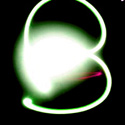
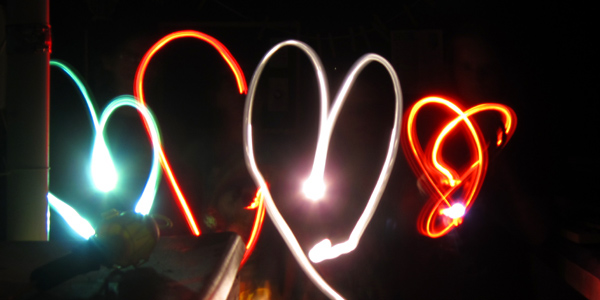
Did you know you can paint with light? You can! And, the girls taking our digital photography class last summer at camp gave it a try. It’s not really hard. You just need a very dark room, a flashlight, a tripod for your camera, and your imagination. The technical part is easy too. Just set your camera, while it’s steady on the tripod, for a long exposure. Then while the shutter is open, you move the flashlight around as a paintbrush.
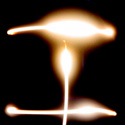

Using different colored filters on the flashlight and moving it in patterns makes these great photographs. They really have an amazing sense of movement, almost like they’re still swirling around. Here are a few examples the girls last summer made. Can you tell what they say? 🙂
 |
 |
 |
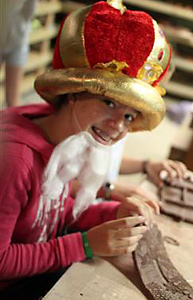 There was a little bit of Potter Mania at Rockbrook today. Marking the release in theaters of the final Harry Potter film, we decided to decorate RBC in all things HP. We of course had plenty of campers and counselors dressing up as characters from the series— lots of maroon and gold, green and black stripes, Harry Potter shaped eye glasses, and lightning bolt shaped scars (drawn with dark eye liner or paint) on dozens of foreheads. Some of the campers clearly planned for this day because their costumes included more elaborate hats, capes, wigs and make up. Girls were decorating magic wands, and carrying them around, would shout out spells now and then with a sly giggle and in their best English accent. Several of the counselors and the Hi-Ups really pulled out the stops by decorating the dining hall like the Great Hall of the Hogwarts Castle: Gryffindor, Hufflepuff, Slytherin, and Ravenclaw, all represented. The equestrian staff even put together a game of Quiddich for the girls, keeping the theme going. This involved riding around a series of cones and, from atop their horse, trying to toss a small ball through a hula hoop at one end of the ring. The whole day was very imaginative and fun.
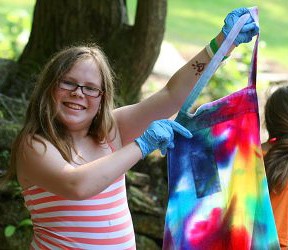
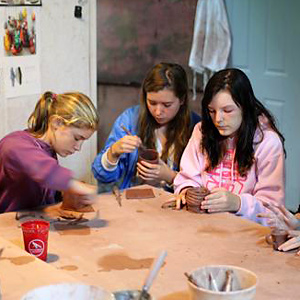 You may have noticed this from checking the online photo gallery, but one of the neat things about life at Rockbrook is how much time the campers here spend doing things with their hands. Everywhere the girls are making things, building things, and decorating things. All of the arts and crafts activities are examples of this (weaving, painting, sewing, ceramics, etc.), but so are the adventure activities (climbing and paddling, e.g.), the sports (archery and riflery, e.g.) and even the horseback riding. These girls are working with all kinds of physical materials, manipulating, shaping and arranging real, not virtual, things. They are, in this way, connecting to the physical world, often to nature, and to their own sensations and feelings.
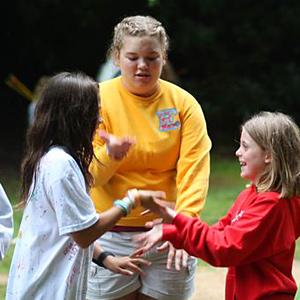 What’s important about this “hands on” experience central to camp life is how much the girls really love it. This may be because the rest of the year lacks the same opportunity for kids to do much with their hands, and it’s simply novel and fun, but it could also be because camp is feeding a hunger. Perhaps kids need chances to work with their hands, to make things, to forge real connections with the physical world, and modern life, with its pre-processing of almost everything, is making “hand work” (working “by hand”) less common. The manual character of camp is satisfying an important need kids don’t even know they have. Instead, they simply know it’s really fun, really satisfying, to make stuff, whether it be a clay pot, a tie dye t-shirt, or even a magic wand. Maybe, we as human beings need this kind of manual experience, and we’ve forgotten it. Thankfully, there is camp to remind our children! As they grow older, we can hope they’ll remember the satisfaction they gained from working with their hands at camp. If so, I suspect they’ll be happier.
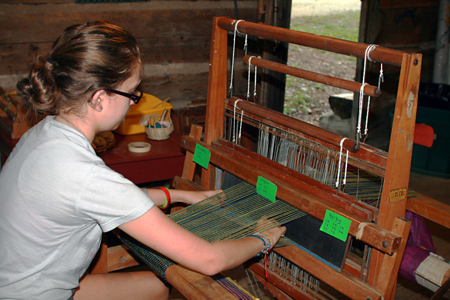
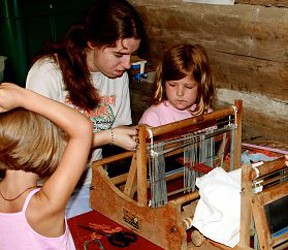
Just about every day at Rockbrook you’ll find kids weaving down in Curosty, one of the nineteenth century log cabins at camp. And there are all kinds of looms in action and weaving techniques going on. You might see rope or finger weaving, for example. Girls could be using a flat lap loom. There are several sizes of tabletop looms, and for the more advanced weavers, kids could be weaving on large floor looms.
This photo shows Emma working on one of our great classic Leclerc floor looms. One of the fiber arts staff members set up the loom (something that takes a lot of time!) and then helped Emma design a pattern for her piece. If you look closely, those green tags are “cheat sheets” for the treadle pattern.
These floor looms take some time to learn how to operate, but with them, kids can weave nice wide fabrics in all sorts of cool designs. It’s a lot of fun, so come on! Let’s weave!
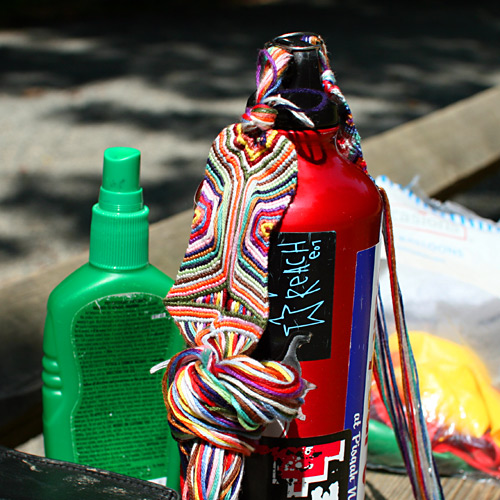
Everyone knows that coming to summer camp means making friendship bracelets. It means heading down to Curosty (our historic crafts, fiber arts, cabin) and learning a few of the many friendship bracelet knots and designs. Some are simple patterns, like these basic bracelet making instructions, that are very quick to learn. Using just a couple of strands of embroidery floss, you can a complete bracelet in just a few minutes.
But take a look at this one! Isn’t it amazing? It might even be a record because it’s got 62 strands of floss. The knots are standard overhand “friendship” knots, but there are so many strands involved, the final bracelet is incredibly wide. We can only imagine how long it’s taken to make!
This is another great example of all the incredible creativity percolating around Rockbrook. Super cool.
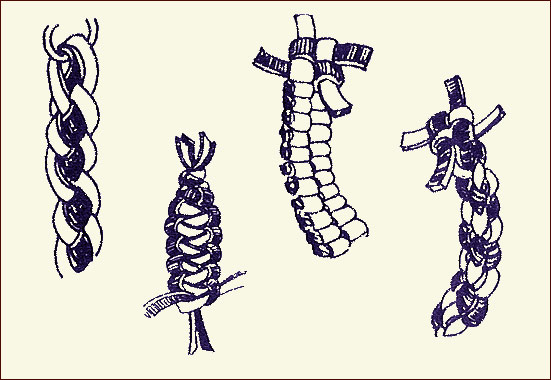
It just wouldn’t be camp without making a lanyard. That flat colorful cord, twisted and tied, seems to be a part of every girl’s summer arts and crafts. Even camp alumni speak fondly of learning to make decorative lanyards.
There are lots of patterns to tie also. Have you seen these four? That first pattern to the left is called the “Diamond Braid” or “Round Braid.” Like most of these braids, getting started is the hardest part. This one is unique too because it’s more braiding that tying knots, and will require a knot at the end to keep it from unraveling.
The second one is usually called the “Cobra Braid” because it makes a flat lanyard reminiscent of a cobra’s head. Some people also call it the “Ladder Knot.” If you know how to tie a square knot, or even how to tie your shoes, you’ll be able to make this lanyard.
The third pattern is probably the best known camp lanyard pattern. Known as the “Box Braid” or the “Square Braid,” it makes a regular 4-sided strand. The important things for this arts and crafts project is keeping your strands straight and your knots tight.
The last pattern shown here is a variation on the box braid, and is usually called the “Round Braid.” To make it, use the same 4-strand weaving knot, but each new knot makes a slight turn crossing over (rather than parallel to) the previous knot. Like all these patterns, you repeat the knot and braiding over and over until your lanyard is long enough or you run out of cord.
Don’t forget that these are just starting points. You can combine them, switch from one the other, add a twist to a strand, or maybe even add a bead to create your own summer arts and crafts project. Go ahead and experiment, and you’ll have something really cool.